REVIEW · ISTANBUL
Afternoon Bosphorus Cruise Luxury Yacht with Professional Guide
Book on Viator →Operated by Yacht Cruises: Bosphorus · Bookable on Viator
That first glide off the dock tells you Istanbul is different.
This afternoon Bosphorus yacht cruise is a smart way to see the city’s top waterfront icons—Dolmabahçe Palace, Ottoman palaces, the Maiden’s Tower, and the skyline around the Golden Horn—in just about two hours. I really like the pacing (enough time for photos without turning your day into a marathon) and the onboard treats, including fresh lemonade, fruit, cookies, and baklava. One thing to consider: it’s still time on open water, so if you get motion sickness or have vertigo, this may not be the best fit.
What makes it feel like more than a sightseeing boat ride is the live guidance. The cruise runs with a smallish group (up to 30), and when the guide is on form—like Celil, whose explanations guests rave about—you start seeing patterns in the architecture and geography, not just landmarks. You’ll want good weather, because this experience depends on it.
In This Review
- Key highlights at a glance
- Why this Bosphorus cruise works: 2 hours, big sights, low stress
- The Bosphorus Strait: the “map” you can see from your seat
- Dolmabahçe Palace from the water: Ottoman power in white stone
- Çırağan Palace: marble glamour with a darker past
- Ortaköy + the Bosphorus Bridge: photos, snacks, and people-watching energy
- Rumeli Hisari and Anadolu Hisari: fortresses built to control the narrowest point
- Küçüksu Pavilion and Beylerbeyi Palace: summer life on the Bosphorus
- Maiden’s Tower (Kız Kulesi): the skyline story you’ll remember
- Galata Bridge and Galata Tower: Golden Horn energy in one sweep
- The onboard comfort and included snacks: the real value
- Celil’s guide style: why the commentary makes the views stick
- Who should book this cruise—and who should skip it
- Should you book this afternoon Bosphorus yacht cruise?
- FAQ
- How long is the afternoon Bosphorus cruise?
- What time does the cruise start?
- What’s included with the ticket?
- Are alcoholic beverages included?
- Is the cruise offered in English?
- Who should avoid this cruise due to motion issues?
Key highlights at a glance
- Luxury yacht comfort for 2 hours with a restroom onboard, plus bottled water and tea/coffee
- Professional English guiding that helps you connect the dots across Europe and Asia
- Included food that’s actually worth looking forward to, with fresh seasonal fruit, cookies, and baklava
- Bosphorus scenery that explains itself: palaces, fortresses, and towers lined along the strait
- Icon views from both sides, including the Bosphorus Bridge area and the historic Golden Horn sights
Why this Bosphorus cruise works: 2 hours, big sights, low stress
Istanbul’s best views are often the hardest to “package.” This cruise solves that by doing the one thing Istanbul does well on a schedule: it shows you the city from the water.
At around 2 hours, you get enough time to settle in, enjoy the breeze, and still catch a full run of major waterfront landmarks. The group size cap (up to 30) matters too. You’re not stuck in a huge crowd where the guide’s voice vanishes and your photos end up blurry because you’re always ducking around strangers.
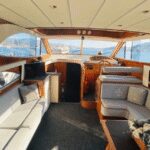
The onboard setup is also geared for comfort. You have a restroom on board, plus complimentary drinks like homemade lemonade with fresh mint, water, tea, and coffee. And yes, they also bring out a prepared seasonal fruit plate, along with cookies and baklava. In a city where food plans can get complicated fast, that’s an easy win.
The overall feel is practical: you’re not scrambling for tickets, you’re not hiking, and you’re not racing through museums. You’re just moving slowly past some of Istanbul’s most recognizable faces—palaces, fortresses, and the skyline characters that show up on postcards because they’re actually worth it.
You can also read our reviews of more tours and experiences in Istanbul.

The Bosphorus Strait: the “map” you can see from your seat
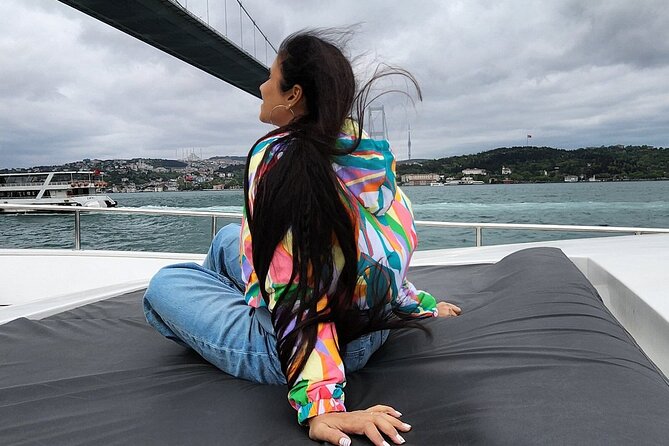
The cruise’s backbone is the Bosphorus, the strait that separates Europe and Asia and connects the Sea of Marmara with the Black Sea. Even if you’ve seen photos, seeing the Bosphorus in motion changes how you understand Istanbul.
A couple of details help the view click. The Bosphorus runs roughly northeast to southwest and sits about 30 kilometers long. It’s not a shallow channel either—the depth averages around 60 meters, with the deepest point reaching about 120 meters. That matters because you’re not gliding over a narrow canal. You’re traveling through a real international waterway with shifting currents.
The current story is interesting in a hands-on way: surface currents tend to move from the Black Sea toward the Marmara, while undercurrents run the opposite direction. The occasional counter-currents on the surface are part of why you may feel the water behave differently at different moments.
Your guide uses these facts to make the scenery make sense. When you see palaces and fortresses clustered along the shores, it’s not random. This was the doorway for centuries—easy to defend, hard to ignore, and too strategically valuable to leave alone.
Dolmabahçe Palace from the water: Ottoman power in white stone
One of the first big “wow” moments is Dolmabahçe Palace, set along the Bosphorus in Beşiktaş. This is an Ottoman palace spread over about 250,000 square meters, with its setting right between the shore and the city streets that run from Kabataş to Beşiktaş.
What I like about seeing it from the yacht is the scale. From land, palace walls can feel flat—just surfaces and gates. From the water, you get the visual logic: this is a residence built to face the strait. It’s also easy to understand why the location became so important. Dolmabahçe started as a cove where ships anchored in ancient times, and later it became a favored residence of the sultans.
If you’re the type who likes spotting details, watch how the palace sits opposite the Asian side, across from areas like Üsküdar and Kuzguncuk. The guide’s commentary helps you read the shore as a connected system, not separate neighborhoods.
Çırağan Palace: marble glamour with a darker past

Next up is Çırağan Palace, commissioned by Sultan Abdulaziz and designed by architect Sarkis Balyan. The palace is famous not just for its beauty, but for its long memory.
A few facts you can keep in your head as you pass: construction finished in 1871, and the palace covers about 80,000 square meters. It’s described as being made of marble and built on the site where a former wooden summer palace once stood.
The story turns sharper after Abdulaziz was deposed—he was imprisoned here for years with his family. Later, when Murat V was deposed, he and his family were also imprisoned here for 29 years. That adds weight to the views. The waterfront looks elegant, but history reminds you that these waters didn’t only host celebrations. They also witnessed power struggles.
In the early 1900s, the palace even took on a new role after the Second Constitutional Monarchy in 1908, briefly serving as a House of Parliament before a fire in 1910 damaged it. After restoration in the early 1990s, it reopened as a luxury hotel—so even today, the building’s identity includes glamour, but now it’s tied to modern hospitality.
Ortaköy + the Bosphorus Bridge: photos, snacks, and people-watching energy
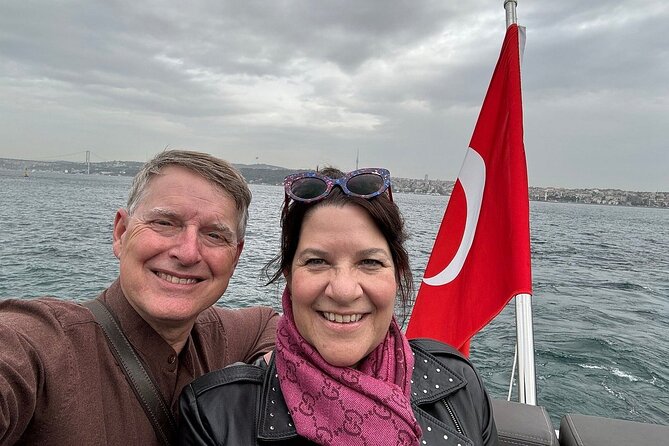
You’ll pass by Ortaköy, a Beşiktaş neighborhood on the European side that sits on the slopes along a valley opening to the coast. Ortaköy is one of those places where Istanbul’s casual life and Ottoman-era waterfront drama share the same frame.
The Ortaköy Bazaar area is described as lively throughout the day, with an “intellectual market,” souvenir shops, cafes, bars, and restaurants. The timing matters though—early hours can feel quieter until things ramp up after around 10:00 am. Since your cruise starts in the early afternoon, you’re likely catching it at a good moment to imagine what the street vibe looks like.
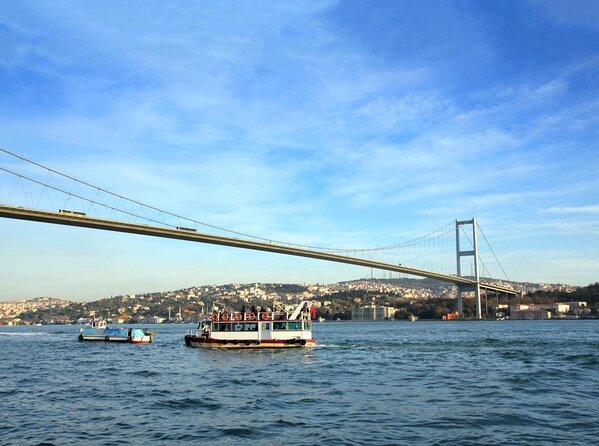
Then there’s the Bosphorus Bridge area. The cruise highlights the feet of the suspension bridges, with the Bosphorus Bridge being the first bridge across the strait. It began construction in 1970 and opened on 29 October 1973, marking the 50th anniversary of the Republic. That means the bridge isn’t just infrastructure—it’s part of the modern identity of Istanbul.
Look for how the bridge frames the strait. From the water, the structure feels like a visual hinge between the European and Asian sides. The guide can also point out how this bridge fits into everyday life, not only as a crossing but as a symbol that shows up in marathon routes and city imagination.
- Bosphorus Yacht Cruise with Stopover on the Asian Side – (Morning or Afternoon)
★ 5.0 · 1,657 reviews





Rumeli Hisari and Anadolu Hisari: fortresses built to control the narrowest point
If you want a “why it’s here” moment, the forts are it. The Bosphorus narrows at key points, and the Ottoman response was fast and intense.
On the European side is Rumeli Fortress (Rumeli Hisarı) in Sariyer. It was constructed directly across from Anadolu Hisari. Construction started in 1453 on the order of Sultan Mehmet the Conqueror, placed at the narrowest part of the Bosphorus. The timeline is striking: it was completed in just three months. Before the conquest of Istanbul, it served to protect against naval attacks. After the conquest, it became an inspection point for maritime traffic.
On the Asian side is Anadolu Fortress (Anadolu Hisari) in Beykoz. It was built in 1395 by Beyazit I and includes a citadel plus exterior castle walls. After the conquest, its strategic importance declined, and the area was converted into a military hospital. Over time, waterfront houses and old mansions grew among the ruins.
A restoration from 1991 to 1993 turned it into a museum area, but with limited public access. From your cruise perspective, the most important thing is the view relationship: you’re seeing both sides of the story, like two pages of the same defensive book.
Küçüksu Pavilion and Beylerbeyi Palace: summer life on the Bosphorus
One of my favorite ways to read Istanbul is through its summer palaces. They show how rulers used this waterway not just for control, but for comfort and display.
The cruise route includes Küçüksu Pavilion, a museum area tied to Ottoman rulers who used it as a summer palace and hunting lodge. The idea here is simple: the Bosphorus wasn’t only for armies and politics. It was also for leisure.
Then comes Beylerbeyi Palace, built in the 1860s on the Bosphorus shores and now positioned right under the Bosphorus Bridge. It was designed by Sarkis Balyan and blends styles—renaissance, baroque, and elements from both Eastern and Western design traditions.
The layout is the kind of detail you appreciate when you can see it from a moving viewpoint. The main building is a two-store stone structure on a high basement, set on a land area of about 2,500 square meters. The complex includes 6 halls, 24 rooms, and a hamam (and a bathroom). The south side is associated with the Imperial Mabeyn and the north side with the Valide Sultan’s Apartment.
If you want a checklist for what to look for, focus on the garden and lily pond. Even without stepping inside, you can often pick out the geometry of the grounds, which makes the palace feel less like a single building and more like a whole world on the water.
Maiden’s Tower (Kız Kulesi): the skyline story you’ll remember
Some Istanbul icons work because of their design. Others work because of their legend. Maiden’s Tower (Kız Kulesi) is both.
It sits on a tiny island about 200 meters from the shore near Üsküdar. The tower is famous for legends, especially the one about a sultan and his daughter. An oracle predicts she’ll be killed by a snake bite on her 18th birthday. To stop it, the tower is built as a place where she can live in secrecy and protection.
Then comes the twist: on the 18th birthday, she receives a basket of fruits. A snake hides inside the basket, and she’s bitten—exactly as foretold.
Even if you’ve heard the story before, seeing the tower as a distinct shape in the Bosphorus skyline makes it feel more real. It’s not just a tower; it’s an island-stage for a moral tale. And from a cruise seat, the tower becomes a moving “anchor” in your photos—an easy landmark to orient yourself around.
Galata Bridge and Galata Tower: Golden Horn energy in one sweep
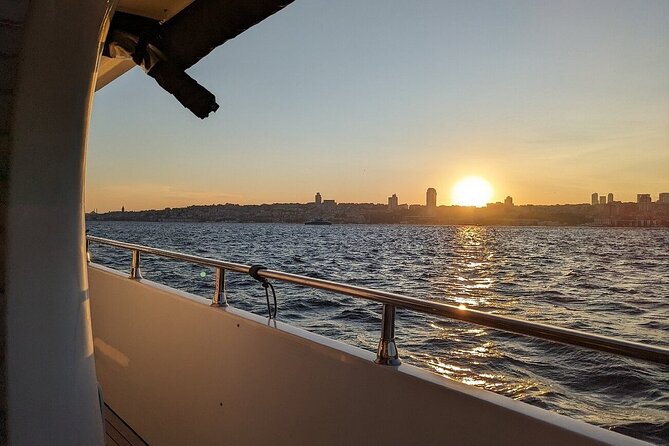
After the Bosphorus sights, the cruise also brings you into the world of the Golden Horn.
The Galata Bridge (Galata Köprüsü) spans the two sides of the Golden Horn and has a long history. It began in 1845, changed over time, and was damaged by fire in 1992. A new bridge replaced it, while the older structure was moved to Halic.
This bridge matters because it’s both transportation and daily life. Below, you’ll find restaurants, cafes, and hookah lounges. Above, tramway and pedestrian traffic flow. And you can also picture the scene from the way the bridge is described: fishing from the bridge, ferries docking nearby, and street peddlers adding motion.
For skyline views, the Galata Tower is the other major stop. Built by Genoese in 1348, it rises 66.90 meters and was the tallest building in the city when it was built. In the Ottoman era, it served multiple functions, including a fire observatory and a jail.
One story associated with the tower stands out: in 1632, Hezarfen Ahmet Çelebi reportedly glided from the top across the Bosphorus to Üsküdar using self-constructed wings. Storm damage also shaped the tower’s later appearance. In 1875, the conic roof was destroyed and not restored during the rest of the Ottoman era. Then in the 1960s, the conical cap was restored and the interior was updated. Today, the tower is open to the public and has a restaurant and café at the upper floor.
From the water, the tower looks tall, clean, and unmistakable. It’s a strong close to the cruise because it ties together Istanbul’s layers—Genoese engineering, Ottoman reuse, and modern sightseeing.
The onboard comfort and included snacks: the real value
A Bosphorus cruise is only as good as the “small stuff” you don’t have to think about. Here, you get the basics that make the ride pleasant instead of tiring.
You’ll have restroom on board, which sounds obvious until you’ve tried squeezing a restroom into a busy Istanbul day. Drinks are complimentary: homemade lemonade with fresh mint, plus water, tea, and coffee. That’s a nice balance—something cold, plus warm options if you feel chilly on the water.
Then there’s the food: a daily prepared fresh seasonal fruits plate, along with cookies and baklava served aboard. This is one of those inclusive touches that makes a short cruise feel complete. If you’re planning a day with museum time or a long walk later, being fed without hunting for snacks first is genuinely helpful.
Alcoholic beverages are not included, so if you want wine or beer, you’ll need to handle that separately. Also, the cruise is weather dependent. When conditions aren’t right, you may be offered a different date or a full refund.
Celil’s guide style: why the commentary makes the views stick
The highest praise you’ll see for this cruise is about the guide, and a name comes up often: Celil.
From what I’d aim to watch for in a good guide, Celil seems to hit the exact sweet spot. The commentary is clear enough that you can understand what you’re seeing right now. It’s also kind and patient, which matters on a short cruise when people want time for photos but also want the story.
If you’re the type who usually tunes out tour talk, give the guide a chance anyway. This itinerary is packed with palaces, forts, bridges, and legends. With the right explanations, those details stop feeling like a list and start turning into a mental map of Istanbul—Europe and Asia, old defenses, imperial showpieces, and modern symbols.
Who should book this cruise—and who should skip it
This works best for:
- People who want maximum waterfront sights without a full day commitment
- First-time Istanbul visitors who need a fast way to orient themselves
- Couples and small groups who like photos and clean logistics
- Anyone who enjoys Ottoman-era landmarks as part of the city’s everyday geography
I’d skip it or think twice if:
- You have vertigo or seasickness concerns. The tour description specifically warns it isn’t recommended for those conditions.
- You hate time on the water, even when the ride is only about two hours.
If you’re on the fence because you’re worried it’ll feel rushed, don’t worry too much. The schedule is short by design, and the included snacks and comfort features help you settle in instead of constantly planning the next step.
Should you book this afternoon Bosphorus yacht cruise?
Yes, if you want an easy, high-value way to see Istanbul’s most famous waterfront sights in about two hours, with English guiding, comfortable onboard basics, and food that doesn’t feel like an afterthought.
Book it if you’re excited by palaces and skyline icons—Dolmabahçe, Çırağan, Beylerbeyi, Maiden’s Tower, and the Galata views from the Golden Horn. The guide name you’ll hear most, Celil, is a strong sign that you won’t just get silent sightseeing.
Pass if you’re prone to motion sickness or vertigo. Also, if you already plan to spend the day on foot and want deeper museum time, this is more about the water-and-views angle than slow indoor exploration.
Overall, this is a smart “Istanbul highlights” cruise that feels comfortable, well paced, and guided in a way that helps you understand what you’re seeing while you’re still seeing it.
FAQ
How long is the afternoon Bosphorus cruise?
It lasts about 2 hours.
What time does the cruise start?
The start time is 1:00 pm.
What’s included with the ticket?
The cruise includes 2 hours on a luxury yacht, a restroom on board, complimentary drinks (homemade lemonade with fresh mint, water, tea, and coffee), and a prepared onboard seasonal fruit plate plus cookies and baklava.
Are alcoholic beverages included?
No. Alcoholic beverages are not included.
Is the cruise offered in English?
Yes. The experience is offered in English.
Who should avoid this cruise due to motion issues?
It’s not recommended for vertigo and seasickness.