REVIEW · ISTANBUL
Private Luxury Yacht Cruise on Bosphorus
Book on Viator →Operated by Tour Book Turkey · Bookable on Viator
Two hours, pure Bosphorus magic. This private yacht cruise is a smart, low-effort way to see Istanbul’s palaces, bridges, and neighborhoods from the water, with English support and a crew that explains what you’re seeing. I especially like the homemade lemonade with fresh mint, plus the laid-back snack spread of fresh seasonal fruit, cookies, and baklava. In a lot of real trips, a main point of contact like Erdal helped keep things smooth and friendly.
The second big plus is how flexible it feels for your day: you choose a departure time, and the whole experience is designed around relaxing (not rushing). One consideration: this isn’t recommended if you get vertigo or seasickness, and the cruise depends on good weather.
For value, it works best when you fill the boat. The price is per group (up to 12), and once you spread it out among friends or family, you’re paying for prime views, comfort, and onboard refreshments without dealing with transport stress.
In This Review
- Key things I’d focus on before you book
- Bosphorus views you can actually enjoy for two hours
- What makes this private yacht cruise feel like a treat
- Price and value: where the math gets interesting
- Your 2-hour plan: picking a departure time that makes sense
- Dolmabahçe Palace: the grand entrance you see from the water
- Çırağan Palace and Ortaköy: luxury buildings and street-life energy
- Bebek, the Bosphorus Bridge, and the city’s “signature lines”
- Rumeli Hisarı and Anadolu Hisarı: fortresses that shape the narrowest point
- The palaces you get almost “under the bridge”
- Maiden’s Tower and the bridges: legends from the waterline
- Galata Bridge and Galata Tower: the Golden Horn angle
- Snacks, drinks, and restroom comfort that actually matter
- Who this cruise fits best
- Should I book this Bosphorus yacht cruise?
Key things I’d focus on before you book
Private setup for your group: Only your party is on the yacht, so it feels calmer than standard sightseeing.
Fruit, cookies, and baklava included: Plus drinks like homemade lemonade, tea, coffee, and water.
Two-hour timing that fits most Istanbul days: Pick a departure time that matches your plans and light.
Big landmarks from one continuous ride: You get palace and bridge views without constant stops and ticket lines.
Weather and motion matter: If you’re prone to seasickness, you’ll want to think twice.
Bosphorus views you can actually enjoy for two hours
Istanbul looks great from land, sure. But from the Bosphorus, the city’s layout clicks fast. You see why this strait is the hinge between continents: it separates Europe and Asia while connecting the Sea of Marmara and the Black Sea. It’s about 30 kilometers long, and the water is deep enough to feel serious—around 60 meters average, with deeper points reported up to 120 meters.
That depth matters because the Bosphorus isn’t just scenic. It has currents: surface water tends to flow from the Black Sea toward the Marmara, while undercurrents move the other way. On the ride, you don’t need a science lesson. You just feel that Istanbul’s waterfront is shaped by real water movement, not postcard stillness.
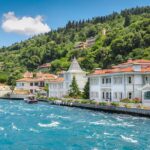
The cruise also gives you a “both-sides” perspective. You’re not only staring at one shoreline. The route typically highlights historic palaces and fortresses along the European and Asian banks, then layers in the city’s modern bridge silhouettes. It’s a rare mix of classic Ottoman-era landmarks and the engineering landmarks Istanbul became known for later.
You can also read our reviews of more tours and experiences in Istanbul.
What makes this private yacht cruise feel like a treat
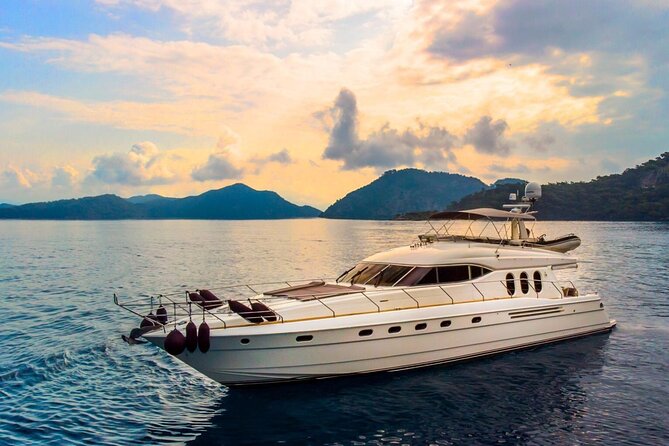
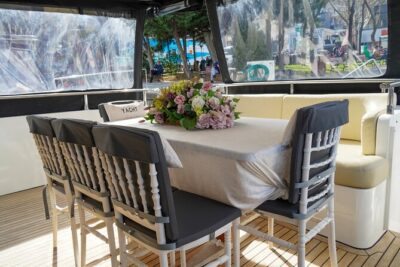
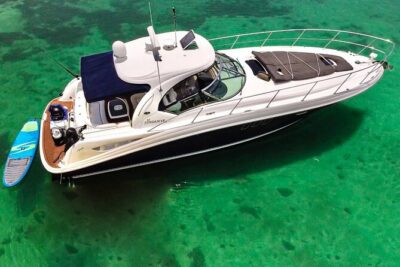
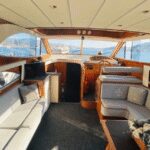
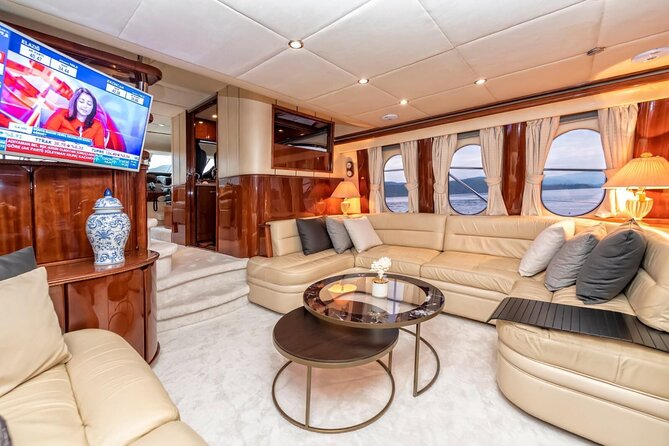
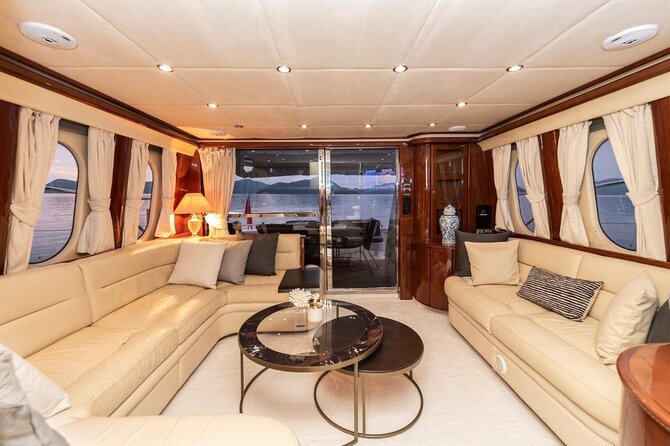
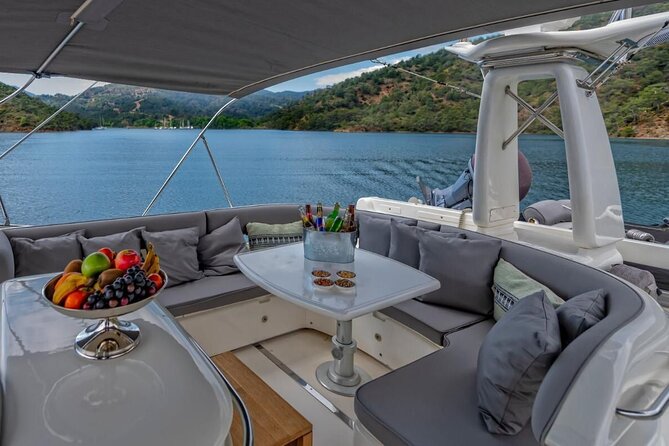
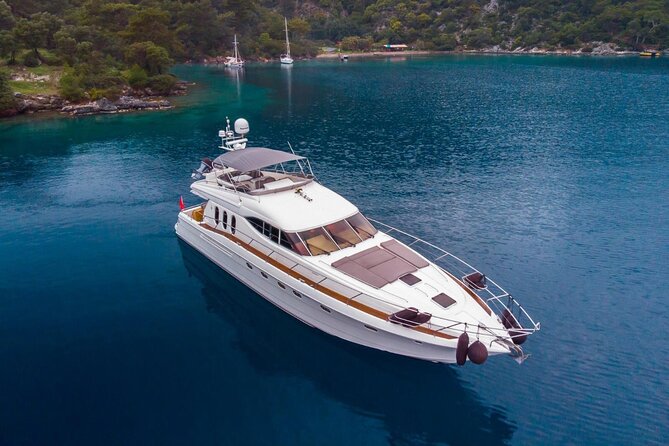
This isn’t a long day of schedules and switches. It’s a focused two-hour cruise where the goal is comfort and views. The yacht is described as luxury and decorated with passenger comfort in mind, and it comes with an onboard restroom—huge for a two-hour outing.
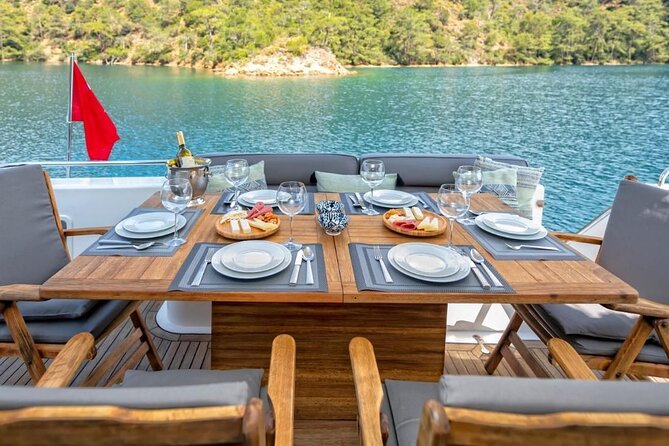
The included food and drink plan is also a practical win. You get a daily prepared fresh seasonal fruits plate, plus cookies and baklava. Drink-wise, you’re covered with homemade lemonade made with fresh mint, water, tea, and coffee. Alcoholic beverages aren’t included, so if you’re hoping for wine or champagne as part of the base deal, you’ll need to plan accordingly.
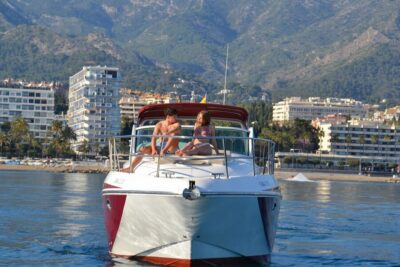
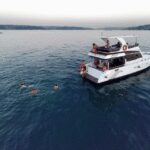
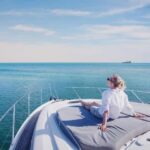
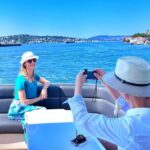
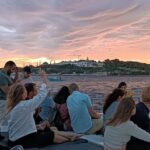
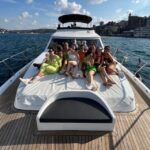
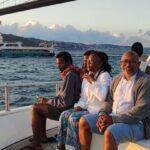
One detail I like in particular is that this feels intentionally social without being loud. Some groups use the open deck space for photos and the covered areas for shade or comfort when the sun hits. In at least one real family group, the boat’s multiple spaces—covered, semi-covered, and open—made it easy for people of different ages to enjoy the same trip without anyone feeling trapped in one spot.
Price and value: where the math gets interesting
The price is listed as $347.22 per group, up to 12 people, and the cruise lasts about 2 hours. That means your real cost per person depends entirely on how full your group is.
- If you fill it with 12 people, you’re effectively around $29 per person.
- If you’re closer to 10 people, it’s closer to $35 per person.
Either way, you’re not paying “private yacht for two people” pricing. You’re paying private-yacht pricing for a group that can actually share the cost. For Istanbul, where the Bosphorus views can get crowded fast, that trade can feel fair—especially because the package includes refreshments and keeps the outing low-stress.
You should also factor in what you’re saving. You’re not coordinating a complex route across neighborhoods and bridges. You’re not squeezing into long lines for individual landmarks just to get a skyline view. Instead, the water does the connecting for you.
Your 2-hour plan: picking a departure time that makes sense
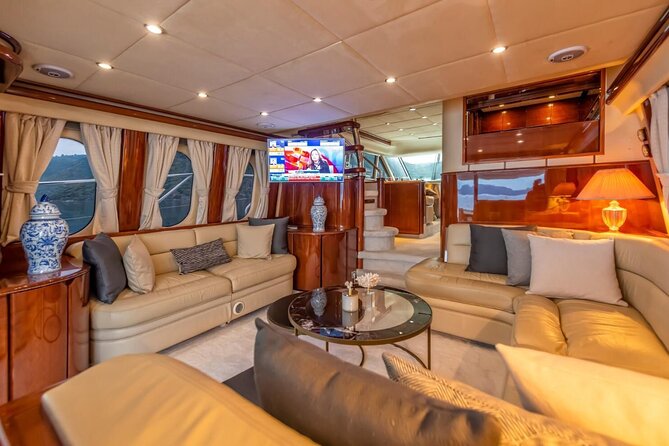
You choose the departure time. That matters more than it sounds. On the Bosphorus, light changes fast, and the skyline works differently depending on the hour. A late-day departure can help you get softer light on palace facades and bridge structures. A daytime departure can make it easier to read details as you pass waterfront buildings.
The pace also tends to be relaxed. A common theme in positive experiences is that people didn’t feel rushed, and the crew adjusted the flow when needed. In one case, a group expected a guide and found there wasn’t one at first. The hostess helped secure a guide from a nearby dock, and the captain stopped to pick him up so the narrative wouldn’t be lost. That’s the kind of practical problem-solving that turns a trip from just scenic into genuinely enjoyable.
Two quick planning tips:
- If you’re marking a celebration, ask ahead. There’s at least one account of a birthday cake being arranged onboard.
- Wear something comfortable and plan for sun and wind. Even in good weather, the Bosphorus can feel breezy.
Dolmabahçe Palace: the grand entrance you see from the water
One of the most satisfying parts of this cruise is how it positions the big Ottoman-era statements along the shoreline. Dolmabahçe Palace is one of those. It sits in Beşiktaş on a large 250,000 m² area, between Dolmabahçe Street stretching from Kabataş to Beşiktaş, and the Bosphorus itself.
From the water, you get the feeling of a palace addressing the strait. Dolmabahçe was once a cove where ships anchored in ancient times, and that sea-facing relationship still shows. You’re not stuck staring at a distant photo. You’re seeing the scale and location that made it a favorite residence of the sultanate.
The potential drawback here is also practical: you typically won’t be stepping out of the yacht for a long palace visit during a two-hour cruise. The value is the visual and interpretive angle—how the palace sits at the Bosphorus entrance from the Sea of Marmara—rather than a full inside tour.
- Bosphorus Yacht Cruise with Stopover on the Asian Side – (Morning or Afternoon)
★ 5.0 · 1,657 reviews

Çırağan Palace and Ortaköy: luxury buildings and street-life energy
Çırağan Palace is the kind of Ottoman marble statement that looks even more dramatic from the water. It was commissioned by Sultan Abdulaziz and designed by Sarkis Balyan. Construction finished in 1871. It’s reported as marble and spread over 80,000 m².
What I like about seeing it from the Bosphorus is that you get the sense of both power and tragedy. After Abdulaziz was deposed, he was imprisoned there for years with his family. Murat V faced similar imprisonment for decades after his deposition. Then the palace later shifted uses—after the Second Constitutional Monarchy it was used as a House of Parliament, then damaged by fire in 1910, and eventually restored and reopened as a luxury hotel in the early 1990s. Watching these building stories unfold as you sail helps the architecture feel like living history rather than just an exterior.
After the palaces, the cruise typically moves past Ortaköy. Ortaköy is a Beşiktaş neighborhood on the European side, shaped by slopes along a valley opening to the coast. Its bazaar area is lively throughout the day, with an especially noticeable flow after 10:00 am. From the yacht, you get that vibe without the walking and negotiating that comes with bazaar visits.
Bebek, the Bosphorus Bridge, and the city’s “signature lines”
Bebek is another shoreline stop that pairs well with yacht travel. It’s a historic residential area with Ottoman roots, and its name literally connects to baby—part of the area’s reputation for being positioned beautifully along the water.
Today you’ll see it as a mix of older buildings and well-known institutions, including Bogaziçi University, plus waterside mansions and restaurants. Again, you’re not going to “do” Bebek in a two-hour cruise. You’re consuming it in the best way for a boat: the long sightlines.
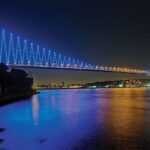
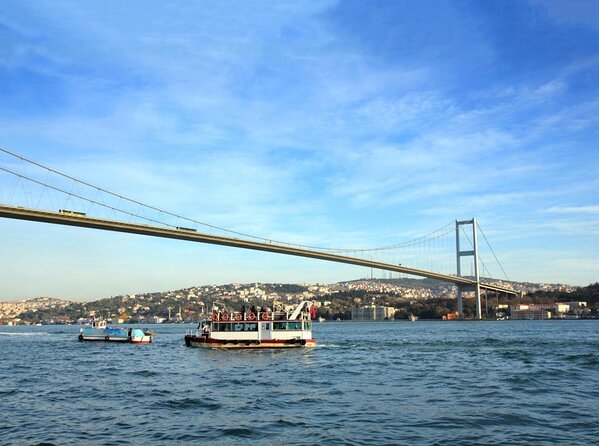
Then comes the Bosphorus Bridge, the first bridge built across the Bosphorus. Construction began in 1970 and it opened on 29 October 1973. It’s an active transportation link, and it’s also crossed during the Istanbul Eurasa Marathon. From Ortaköy on the European side to Beylerbeyi on the Asian side, the bridge is one of those Istanbul icons that feels like a marker line between eras.
A possible drawback: because the bridges carry heavy traffic, you’ll see modern movement in your frame. If you’re hoping for a purely historical view with no “city infrastructure” interruptions, you might find it changes the mood. For most people, though, that mix is part of what makes Istanbul feel real.
Rumeli Hisarı and Anadolu Hisarı: fortresses that shape the narrowest point
The Bosphorus gets tight in key areas. That’s why the fortresses were built where they were. Rumeli Hisarı (Rumeli Fortress) sits in Sariyer on the European side, directly across from Anadolu Hisarı. Construction began in 1453 on the order of Sultan Mehmet the Conqueror, and the fortress was completed in just three months.
From the water, it’s easier to grasp the strategic thinking. Before the conquest of Istanbul, it protected against naval attacks. After the conquest, it served as an inspection point for maritime traffic on the Bosphorus. Today, the fortress is known for concerts in summer and it functions as an open-air theater and museum, with restoration work mentioned as removing older wooden houses in 1953.
On the Asian side, Anadolu Hisarı (Anatolian Fortress) was built in 1395 by Beyazit I. It includes a citadel and exterior castle walls. After the conquest, it lost much of its strategic importance and became a military hospital. It later went through a restoration period from 1991–1993 and was converted into a museum, though the data here says it is not open to the public in the usual way. You can visit the outer walls, and the road passes through—so a cruise can be a good way to see it without turning it into a long hike.
The plus of fortress views from a yacht is that you see how close the shores actually are. The drawback is that you’re still viewing from the water rather than inside. This is a cruise for impressions and angles, not a fortress tour with deep time on site.
The palaces you get almost “under the bridge”
Some of the most dramatic moments on this route can come when you sail by palaces positioned directly beneath bridge spans. Beylerbeyi Palace is one of them. It’s an Ottoman summer palace complex built in the 1860s on the shores of the Bosphorus, and it lies right under the Bosphorus Bridge today.
The palace was designed by Sarkis Balyan and is described as mixing elements from renaissance, baroque, and other influences from both East and West. The main building is two storeys made of stone on a high basement. It’s reported as having six halls, 24 rooms, and it includes a hamam.
I like the practical side of this stop: you’re seeing a palace shaped for leisure, set against the movement of modern city infrastructure. The waterfront garden and lily pond area are part of the palace grounds, and even from the water, the layout gives you more than just a wall of stone.
You can also expect Küçüksu Palace (Küçüksu/Kucuksu Palace) along the route. It’s a small Ottoman summer palace ordered by Sultan Abdulmecit and designed by architect Nikogos Balyan. It sits on the Bosphorus coast road between Üsküdar and Beykoz. The name itself is tied to the view, and it was used by sultans for relaxation. The palace opened as a museum during the Republican period.
Maiden’s Tower and the bridges: legends from the waterline
Maiden’s Tower (Kız Kulesi) is one of those skyline features that almost feels designed for a cruise. It stands on a tiny island about 200 meters from the shore of Üsküdar. The tower’s legends are the kind you can’t stop thinking about after you see it.
The most popular one is about an oracle and a sultan’s daughter. The oracle prophesied she would die from a snake bite on her 18th birthday. The sultan built the tower to keep her hidden and protected. On her 18th birthday, she received a basket of fruits as a gift, reached into the basket, and a snake bite killed her—exactly as predicted. That legend is tied directly to the tower’s name.
Then you may pass or view the Fatih Sultan Mehmet Bridge, the second suspension bridge spanning the Bosphorus. Construction began in 1986 and the bridge opened on 3 July 1988. It’s described as the 14th largest steel suspension bridge in the world. For many people, this is the moment where Istanbul’s scale feels most obvious: old legends and modern engineering sharing the same frame.
Galata Bridge and Galata Tower: the Golden Horn angle
Some Bosphorus cruises stay strictly in that straight channel. In this one, the stops also include the Golden Horn shores, which broadens the experience. The Golden Horn is a horn-shaped inlet and historically important as a trade center. Seeing it from the water adds context to the idea of Istanbul as a city built on sea routes.
Galata Bridge (Galata Köprüsü) spans the Golden Horn. Its history goes back to 1845. It has been rebuilt multiple times, including a new bridge after a fire in 1992. There’s a lively pedestrian and tram angle above it, and food and seating below with restaurants, cafes, and hookah lounges. From a yacht, it can be a great photo moment because it shows daily life patterns without you having to fight for a spot on land.
Finally, Galata Tower (Galata Kulesi) is a strong closer. Built by Genoese in 1348, it’s reported as nine stories and 66.90 meters tall. In the Ottoman era, it was used as a fire observatory and a jail. A famous moment connected to it is Hezarfen Ahmet Çelebi gliding from the top across the Bosphorus to Üsküdar with self-constructed wings in 1632. The conic roof was destroyed during a storm in 1875 and restored in the 1960s, with the interior later replaced by concrete. Today it’s open to public and includes a restaurant and cafe on the upper floor.
Even if you don’t go inside, seeing it from the right angle helps you understand why it remains a top panorama spot.
Snacks, drinks, and restroom comfort that actually matter
If you’ve ever sat on a long city tour with no real food plan, you know why onboard snacks are not a small detail. Here, you get a fruits plate, cookies, and baklava. The drinks list is also clearly non-alcoholic: lemonade with mint, plus tea, coffee, and water.
A lot of the positive energy in real experiences points to attentive staff and the way the food is presented. Some accounts mention Turkish coffee and music. Others mention warm, comfortable boat conditions with plenty of snacks.
One negative note showed up too: one person complained about basic issues like broken chairs/tables and a restroom that wasn’t clean. The operator responded that the yacht is checked and cleaned daily and that restrooms are monitored frequently, with the idea that cleanliness can be affected by consecutive use. The practical takeaway for you is simple: if restroom hygiene matters a lot to you, ask staff on board about the current condition and use it early.
Who this cruise fits best
This is a good match for people who want a meaningful Istanbul experience without a strenuous day. It works well for couples, small groups, and families. In one group, ages ranged widely—from early 20s to early 90s—and the cruise held everyone’s attention because it’s social, view-focused, and not physically demanding.
It’s also a smart pick if you’re not sure which waterfront neighborhoods you want to prioritize. From the yacht, you get a quick scan of how districts look and where the landmarks cluster.
It may not be ideal if:
- you’re dealing with vertigo or motion sickness risk
- you’re expecting a full on-land museum-style itinerary
- you’re hoping for included alcohol (it’s not part of the listed inclusions)
Should I book this Bosphorus yacht cruise?
Book it if you want a private, comfortable two-hour Istanbul reset with palace-and-bridge views that you can’t easily recreate from the street. The value gets better as you fill the group, and the included fruit, cookies, and baklava plus mint lemonade make it feel more like a hosted experience than a basic sightseeing cruise.
Skip it (or rethink) if you’re prone to seasickness or vertigo, or if you need long onshore time at specific sights. Also, if you’re picky about bathroom cleanliness and furniture condition, consider messaging your expectations to the provider before you sail.
If your goal is simple—see Istanbul from the water, relax, and leave with a stack of great photos—this is the kind of outing that tends to deliver exactly that.